How to Make Friends as an Adult

If you've ever caught yourself thinking "I have no friends" — or wondering how you got to a point in life where making a real connection feels so much harder than it used to — you're not alone, and you're not broken. Adult friendships are genuinely difficult in a way that no one really prepares you for, and the fact that you're thinking about it says something good about you.

This isn't a listicle of icebreakers or networking tips. It's an honest look at why adult friendships are hard, what actually moves the needle, and how to start from where you are — not where you wish you were.

And for the moments when you need someone to talk to while you're figuring all of this out — we'll get to that too.
Understanding the problem

Why adult friendships are so hard

The scaffolding disappeared

School and early work life were essentially friendship machines — shared physical space, repeated contact, and enough unstructured time to let things develop naturally. Those conditions created closeness almost by accident. Once they're gone, the infrastructure for making friends disappears with them. Most adults are left trying to build something that used to be built for them.

Time scarcity is real — and it's not a personal failure

Between work, family, health, and the basic logistics of adult life, time is genuinely scarce. The bandwidth that might have gone toward spontaneous hangouts gets eaten up fast. Friendships require energy that most people feel they can't spare, and the guilt around that compounds the isolation. It's not laziness — it's math.

The vulnerability gap

Children and young adults are constantly in situations that require openness — new schools, new teams, new cities. As adults, we lose practice with the low-stakes vulnerability that lets friendships form. The bar for "opening up" gets higher, and the fear of seeming too eager, too needy, or just awkward keeps a lot of potential connections from starting at all.

Rejection hits differently as an adult

When a friendship bid goes unanswered in adulthood, it tends to feel more final and more personal. A slow reply, a cancelled plan, a conversation that didn't land — these can feel like clear signals to stop trying, even when they're just life getting in the way. Adults are better at imagining the worst interpretation.

Social media creates the illusion of connection

Scrolling through updates, liking posts, watching stories — it can feel like being connected while actually deepening the loneliness. Passive social media gives just enough of a social signal to reduce the urgency to reach out, without providing any of the actual nourishment of real connection.

What the evidence says

What actually helps

01

Join recurring activities — not one-off events

The research on adult friendship is clear: repeated, unplanned interaction is the single biggest driver of closeness. A one-time event rarely turns into a friendship. A weekly pottery class, a running group, a book club — the repetition is what does the work. You don't have to be charming at the first meeting. You just have to show up again.

02

Prioritize follow-through over finding the "right" people

Most adults who feel lonely aren't short on acquaintances — they're short on follow-through. The person you had a good conversation with at work, the neighbor you keep meaning to invite over — the connection already exists. The bottleneck is almost always the second step, and the third. The "right" person is often just the person you actually followed up with.

03

Be the one who reaches out first

Almost everyone is waiting for someone else to go first. The awkwardness of initiating feels disproportionate to what it actually signals — which to most people is just "I liked talking to you and want to do it again." Being the one who texts first isn't thirsty. It's rare, and people notice.

04

Have lower-stakes conversations more often

Depth in friendship doesn't arrive in one meaningful conversation — it accumulates. The small check-ins, the funny things you share, the "how was your week" texts that actually get answered — these are the material that intimacy is built from. Lower the stakes and increase the frequency. Waiting for the perfect deep conversation often means having none.

05

Recognize that different people can meet different needs

Friendship doesn't have to come in one form. The person you debrief hard days with doesn't need to be the same person you grab dinner with. Adults often wait for a friendship that meets every need at once, when in practice, most of us build a network of relationships — each meaningful in their own way.

06

Be honest about what you actually need right now

Sometimes the loneliness isn't about not having friends — it's about not having someone to talk to right now, about the thing you're actually going through. The two needs are related but not identical. Being honest about which one you're feeling can point you toward the kind of connection that will actually help.

What is a MindRight Partner?

Think about what it would feel like to have someone who listens without judgment, remembers what you're going through, and check in just because.

Now imagine having that — consistently, every single week — from someone dedicated to supporting you.

That's a MindRight Partner.

A new kind of support. Built for real life.

Woman relaxing at home, smiling while texting on her phone


Get matched for free
  • Start free for 7 days — have a real conversation with your Partner, on us
  • After your trial, membership continues as low as $50/month
  • Cancel anytime before your trial ends
4.8
avg. session rating
3M+ texts exchanged
Thousands of people supported
MindRight was built for you.

"I've never felt so consistently heard. There's no judgment, no advice I didn't ask for, just someone who genuinely shows up for me every single week. I didn't know I needed this until I had it."

"I was skeptical at first. I thought it would feel transactional. But my Partner actually remembers everything. It feels like talking to someone who genuinely cares about where I'm headed."

  • Start free for 7 days — have a real conversation with your Partner, on us
  • After your trial, membership continues as low as $50/month
  • Cancel anytime before your trial ends

How it Works

When you join MindRight:

1.Tell us about yourself(2 min) — Answer a few quick questions and choose your plan. Your free 7-day trial starts immediately.

2. Get matched in 1–3 days — We pair you with a Partner matched to your needs and schedule. Spots are limited.

3.
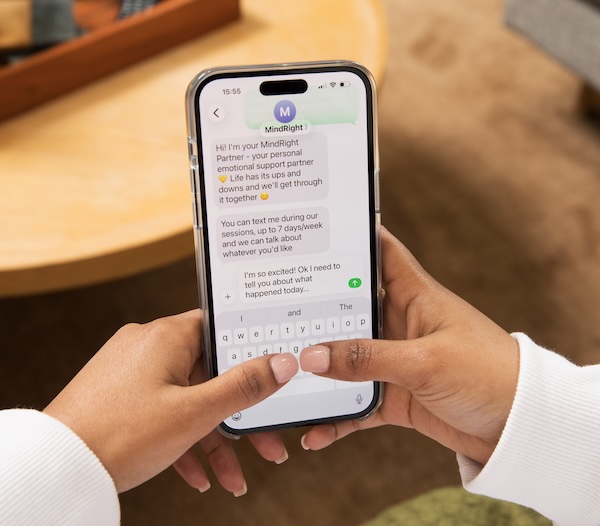
They reach out first — No app. No awkward first move. Your Partner texts you, you respond when ready.

4. Talk about whatever you want — Good days, hard days, everything in between. No agenda, no session clock.

*You don’t have to be “in crisis” to text. We're here to celebrate you on your good days and support you on your tough days.

No app required - it's as easy as sending a text

What members are saying

"It's come at the perfect time. I cannot afford therapy every week - MindRight gets me through the weeks and helps tune my perspective and strengthen me to keep going with everything I have to do as a single mom of 5."

"I loved this experience. My coach has made such a difference. I am learning to do things for myself instead of compromising what I want for everyone else. I've already recommended MindRight to several friends and family."

"MindRight has become an invaluable resource since I lost my therapist. I don't think I would be coping as well without my Partner — I'm so grateful."

thousands of real people supported.
millions of texts exchanged.

Watch: Real testimonials from the MindRight community:
Video thumbnail
  • Start free for 7 days — have a real conversation with your Partner, on us
  • After your trial, membership continues as low as $50/month
  • Cancel anytime before your trial ends

What MindRight Is (and Isn't)


What it
IS

- Text-based support with a REAL person, not AI
- Non-clinical emotional support for everyday life
- A consistent partner to process life as it happens
- Space to celebrate wins and talk things through

What it ISN'T
-
In-person or video support
- A hotline where you're talking to different people every time
-
Therapy or clinical treatment
- Diagnosing, fixing, or prescribing
- For crisis or emergencies

Get support no matter where you are, or what you're doing

FAQs

Yes — we ask for a card to set up your membership plan. But you won't be charged anything until your 7-day free trial ends. Cancel before then and you owe nothing.
Your membership automatically continues at the plan you selected ($50/month). You can cancel anytime before your 7 days are up and you won't be charged.
Tell us. We'll rematch you. We want you to have the right fit — that's the whole point.
No. MindRight Partners are not licensed therapists and do not provide clinical care. Think of it as having a dedicated, vetted human in your corner for the everyday stuff — someone consistent who really knows you. If you need clinical support, we always encourage you to seek it.
Your MindRight Partner is there specifically for you. They're not going to bring their own drama, cancel plans, or get burnt out. Their focus is entirely on supporting you — consistently, every week.

You don't have to do life alone.


Watch a message from our Founder:

Watch a message from Ashley, MindRight Founder
One real conversation. On us. No risk.

Try MindRight free for 7 days. Meet your Partner, have a real conversation, and see how it feels. If it's not for you, cancel before your trial ends — no charge.

Get matched for free

7-day free trial · Cancel anytime